Loading...
Serving Brookline, MA and surrounding areas. (857) 340-2193
Serving Brookline, MA and surrounding areas. (857) 340-2193
A cracked, uneven, or damp basement floor holds back the rest of your home. We install concrete floors in Brookline with proper subbase prep and moisture barriers so you get a surface you can actually build on.
Concrete floor installation in Brookline means removing the old material, preparing the subbase, and pouring a new slab — most residential basements and garages are completed in one to two days of active work, with 24 to 48 hours of curing before the space is walkable.
Many Brookline homes were built before 1940, which means original basement floors were poured thin, without reinforcement, and sometimes directly over soil that was never properly compacted. Replacing one of these floors is more than just a cosmetic upgrade — it is the foundation everything else in a renovated basement or garage depends on.
If your concrete floor project is connected to a larger renovation — like finishing a basement or converting a garage — our garage floor concrete page covers the specific needs of vehicle-bearing slabs, including the thicker pour and finish options that hold up to road salt and tire traffic.
If cracks run across your basement floor and are wide enough to catch a coin — or the surface flakes when you sweep it — the floor has likely reached the end of its useful life. In Brookline's older homes, many original basement floors were poured thin and without reinforcement, so deterioration is common in houses built before World War II.
That white residue on basement floors is efflorescence — mineral deposits left when water moves up through the concrete and evaporates. It is a sign that moisture is actively traveling through your floor from below. In lower-lying parts of Brookline near the Muddy River corridor, this is a common problem that tends to get worse over time if the floor is not replaced and properly sealed.
If you find pooled water on your basement floor after a storm or during spring thaw, your floor either lacks adequate slope toward a drain or has developed low spots from settling. New England's wet springs and heavy snowmelt seasons make this a recurring problem for Brookline homeowners with aging basement floors. A properly installed replacement floor can be graded to drain correctly from the start.
If your garage floor has started to look rough and pitted near the door — where snow and ice melt drips in — that surface breakdown is called spalling, caused by freeze-thaw cycles combined with road salt tracked in on tires. Brookline winters accelerate this process, and once the surface starts breaking down, it moves quickly through the deeper layers.
Every concrete floor installation starts with a full assessment of what is underneath — soil condition, moisture presence, and the state of any existing material. We remove the old floor, compact the gravel subbase, install a moisture barrier where conditions warrant it, and pour a four-inch slab reinforced with steel mesh. Garage floors that need to carry vehicles are poured thicker at five to six inches.
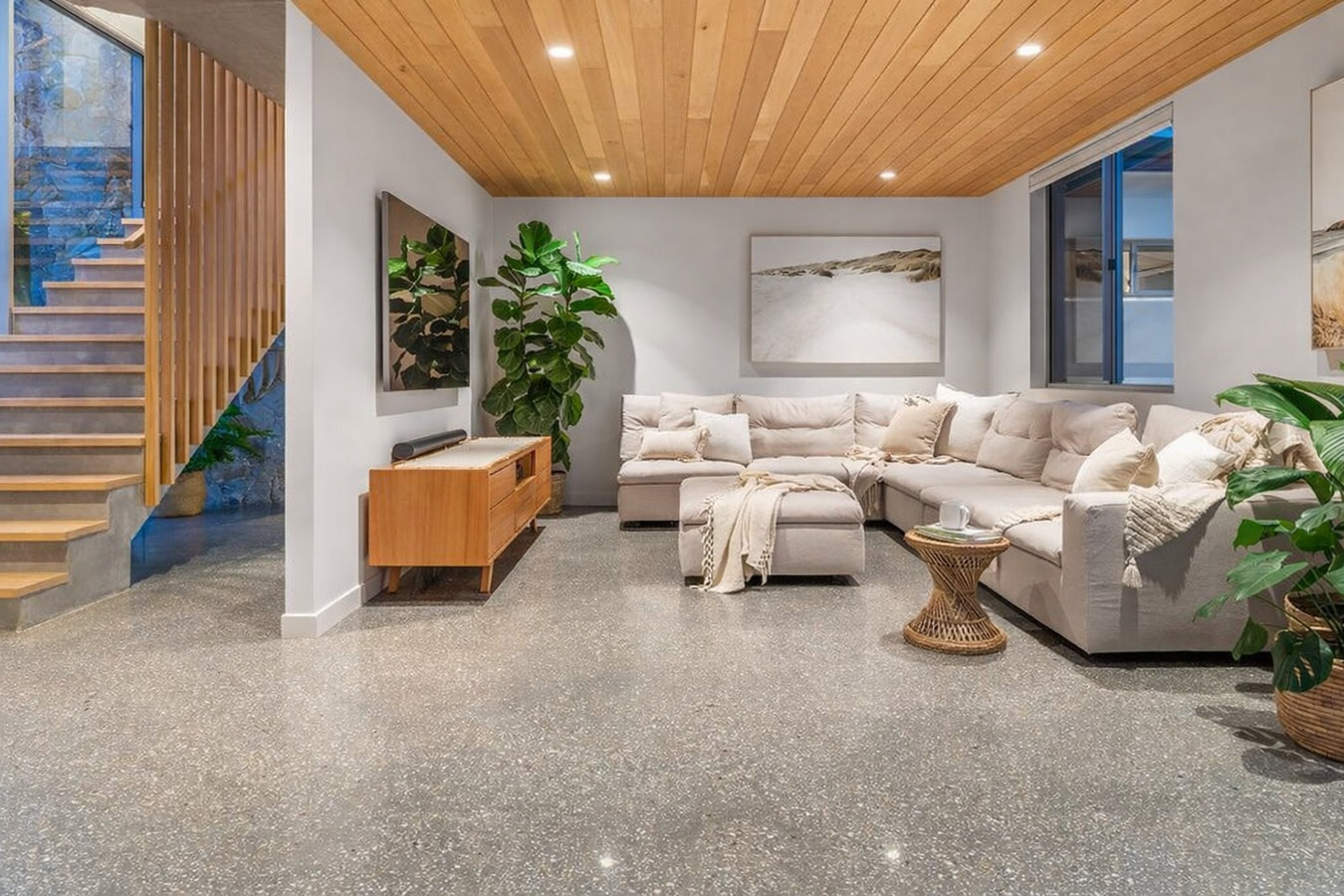
Finish options range from a standard broom texture for utility spaces to a smoother or polished surface if you are planning to add flooring on top or want the concrete itself to serve as the finished floor. Stained and sealed finishes are also available for basement living areas and home gyms. We include permit handling through the Town of Brookline Building Department as part of every project.
Homeowners who want the flexibility of a decorative finish on their new floor will find options on our concrete pool decks page, where we cover the same decorative finishing techniques used indoors and out. For straight garage floor work, see our dedicated garage floor concrete page for vehicle-specific thickness and finish guidance.
For Brookline homeowners replacing original pre-war floors, including full subbase repair and moisture assessment.
Thicker pours designed for vehicle loads, with slip-resistant broom finish and salt-resistant sealing options.
A straightforward four-inch pour with broom finish for mechanical rooms, laundry areas, and storage spaces.
Smooth or polished finish for basements being converted to living space, home gyms, or offices — ready for tile, LVP, or left as the finished surface.
A large share of Brookline's housing stock was built between the 1890s and 1940s — during the streetcar suburb era when the Green Line first made the town accessible from Boston. Those original basement floors were poured under very different standards than today. When contractors remove them, they often find soft spots, old fill material, or long-standing moisture problems that need to be addressed before a new pour can go in. Skipping that prep work is the most common reason basement floors in Brookline fail within a few years of being replaced.
The freeze-thaw cycles that run from January through March are genuinely hard on concrete. A floor poured with the wrong mix or left without proper sealing will show the damage within a few New England winters. We account for local climate conditions in both the mix design and the finishing process — not as an upsell, but as the baseline for a floor that holds up.
Brookline is also one of the most densely developed communities in Massachusetts, which affects logistics on many jobs. We serve homeowners throughout the area, including Cambridge, MA and Somerville, MA, where older housing stock and tight lot access create the same challenges. If you are in Quincy, MA and dealing with a deteriorated basement floor, the same approach applies.
We schedule a visit to see the space in person before quoting. We check the current floor condition, assess moisture, measure the area, and give you a written estimate that separates labor, materials, and prep work. We reply within one business day of your inquiry.
In Brookline, a building permit is typically required for basement floor replacement. We handle the application with the Town of Brookline Building Department and do not start work until the permit is approved. You receive a copy of the permit before the crew arrives.
The crew removes the old floor on day one, compacts the gravel subbase, installs any moisture barrier, and sets the reinforcement. The pour typically happens the same day or the next, depending on the size of the space. The finished surface is textured or smoothed according to your finish choice.
The floor needs 24 to 48 hours before it is walkable and a full week before heavy items go back. We coordinate the town inspection and walk you through the sealing schedule and any other maintenance steps before we leave the job.
No obligation, no sales pitch. We visit your space, tell you exactly what is needed, and give you a written breakdown within one business day.
(857) 340-2193We have replaced floors in Brookline homes built as far back as the 1890s. We know what to expect under an original slab — soft fill, old debris, moisture problems — and we address what we find before pouring, not after. That prep work is what makes a new floor last in a 100-year-old house.
In parts of Brookline near the Muddy River corridor, groundwater is an active concern. We assess moisture conditions before quoting and give you an honest answer about whether a moisture barrier alone is enough or whether additional drainage work is needed first. Pouring over an unresolved moisture issue is a mistake that shows up within one or two seasons.
Some contractors suggest skipping the Brookline building permit to save time. We do not. A permitted job is inspected by the town, giving you independent confirmation that the work was done correctly — and documentation that matters when you sell. You can check contractor licensing directly through the Massachusetts Construction Supervisor License portal.
The Boston area averages around 48 inches of snow per year, and deicing salt is a constant presence in garages and entry areas. We specify concrete mixes and sealing schedules appropriate for this climate, not generic national specs, so your floor holds up through real New England winters rather than just mild ones. Portland Cement Association guidance on curing informs our process.
The combination of proper subbase prep, moisture assessment, and climate-appropriate mix design means you are not replacing a floor that will look rough again in three winters. Those standards are built into every project, not treated as premium options.
Extend the same durable concrete finish to outdoor pool surround areas with slip-resistant texture and proper drainage.
Learn moreThicker pours and salt-resistant finishes purpose-built for garages that take daily vehicle traffic and road salt.
Learn moreSpring fills our calendar fast — the best time to pour before summer heat arrives is now, so reach out today and we will schedule your site visit within the week.